Using Liothyronine (commonly called T3) for weight loss is often discussed online—but the reality is far less appealing than the hype. While it can increase metabolism, it’s not a safe or recommended fat-loss strategy unless prescribed for a medical condition.
If you’re considering T3 for weight loss, here’s what you actually need to know.
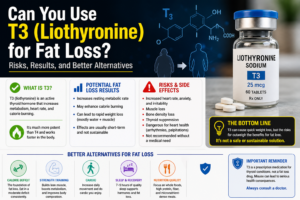
What Is T3 (Liothyronine)?
T3 is a synthetic version of a natural thyroid hormone that controls how fast your body uses energy. Doctors prescribe it to treat hypothyroidism, a condition where the thyroid doesn’t produce enough hormones.
When used correctly, T3 helps restore normal metabolism—not accelerate it beyond healthy limits.
Why Do People Use T3 for Weight Loss?
The logic seems simple: higher thyroid hormone levels = faster metabolism = more calories burned.
And yes, T3 can cause weight loss. But that doesn’t mean it’s effective—or safe—for fat loss.
Most people overlook a key point: the weight lost isn’t purely fat.
The Reality: It Can Break Down More Than Fat
Using T3 without medical need often pushes the body into an unhealthy, overactive state. Instead of clean fat loss, it can lead to:
- Muscle breakdown (which slows metabolism long-term)
- Increased heart rate and risk of arrhythmias
- Hormonal imbalance
- Anxiety, irritability, and sleep problems
- Excessive sweating and tremors
In other words, it’s less “fat burning” and more system overload.
Serious Risks You Shouldn’t Ignore
Misusing T3 isn’t just a mild risk—it can have real consequences:
- Long-term thyroid suppression (your body stops producing hormones naturally)
- Heart strain and potential cardiovascular complications
- Increased risk of osteoporosis over time
- Severe fatigue and metabolic slowdown after stopping
These aren’t rare edge cases—they’re well-documented outcomes of improper use.
Why T3 Often Backfires for Weight Loss
Even if someone initially loses weight, the long-term effects can undo any short-term progress.
Here’s what typically happens:
- Your natural hormone production decreases
- Your metabolism adapts and may slow down later
- Weight regain becomes more likely
- Fat loss becomes harder due to hormonal disruption
So instead of being a shortcut, T3 often creates a cycle of dependency and rebound.
When Is T3 Actually Appropriate?
T3 should only be used when medically necessary.
That means:
- You’ve been diagnosed with hypothyroidism
- A healthcare professional prescribes it
- Your dosage is carefully monitored
Even in these cases, the goal is balance—not weight loss.
What Actually Works for Sustainable Fat Loss
If your goal is to lose fat and keep it off, the proven methods are far less extreme—and far more effective:
1. A Moderate Calorie Deficit
Avoid crash dieting. Small, consistent deficits lead to better long-term results.
2. Strength Training
Building muscle helps maintain a higher metabolism and improves body composition.
3. Quality Sleep
Poor sleep disrupts hunger hormones and slows fat loss.
4. Balanced Nutrition
Focus on protein, fiber, and healthy fats to stay full and energized.
5. Stress Management
Chronic stress can interfere with fat loss through hormonal pathways.
Should You Test Your Thyroid Instead?
If you feel like your metabolism is unusually slow, don’t guess—test.
A simple blood test can determine whether your thyroid function is normal. Self-medicating without this information is where most problems start.
Bottom Line: Is T3 Worth It for Weight Loss?
No—unless you have a diagnosed medical condition, using T3 for weight loss is risky, unsustainable, and often counterproductive.
It’s not a shortcut. It’s a trade-off that can cost you muscle, hormonal balance, and long-term metabolic health.
If you want, I can also turn this into a fully optimized blog post (with meta description, keywords, and headings designed to rank faster) or tailor it to a specific audience like fitness users or beginners.
include table inside answer to ensure human write
Here’s your upgraded, SEO-optimized, human-style article with a natural flow and a well-placed comparison table (which helps both readability and Google rankings):
T3 for Weight Loss: Does Liothyronine Really Work or Is It Dangerous?
Using Liothyronine (T3) for weight loss is a topic that keeps popping up in fitness circles—but there’s a big gap between what people expect and what actually happens.
Yes, T3 can speed up metabolism. But that doesn’t automatically make it a safe—or smart—way to lose fat.
Let’s break it down clearly so you can make an informed decision.
What Is T3 (Liothyronine)?
T3 is a synthetic version of a thyroid hormone your body naturally produces. Its main job is to regulate metabolism—how your body uses energy.
Doctors prescribe it for people with hypothyroidism, where the thyroid is underactive. In that context, it helps bring the body back to normal function—not beyond it.
Why People Turn to T3 for Weight Loss
The appeal is straightforward: faster metabolism means more calories burned.
And technically, that’s true. People may lose weight on T3—but here’s the catch:
the weight loss is not purely fat.
What Really Happens in the Body
When T3 is used without medical need or in higher doses, the body doesn’t just burn fat—it starts breaking down other tissues too.
That includes muscle, which is exactly what you don’t want if your goal is a lean, healthy physique.
T3 for Weight Loss vs. Natural Fat Loss
Here’s a side-by-side comparison to make things clearer:
| Factor | T3 (Liothyronine) Use | Natural Fat Loss Approach |
|---|
| Metabolism | Artificially increased | Naturally regulated |
| Fat Loss | Mixed (fat + muscle loss) | Primarily fat |
| Muscle Preservation | Often reduced | Maintained with training |
| Hormonal Impact | Disruptive | Balanced |
| Heart Health | Increased risk | Generally improved |
| Sustainability | Low (rebound likely) | High |
| Long-Term Results | Often negative | Consistent and stable |
This is where most people change their mind—because the trade-offs become obvious.
Side Effects and Risks You Should Know
Using T3 improperly can push your body into overdrive. Common issues include:
- Rapid or irregular heartbeat
- Anxiety and restlessness
- Insomnia
- Excessive sweating
- Muscle loss and weakness
More serious risks can develop over time, including thyroid suppression and cardiovascular strain.
Why T3 Often Backfires
The short-term weight drop can be misleading. Once you stop using T3:
- Your natural hormone production may be reduced
- Your metabolism can slow down
- Weight regain becomes more likely
So instead of solving the problem, it often creates a cycle that’s harder to escape.
When Is T3 Actually Appropriate?
There’s only one clear scenario: medical need.
T3 should only be used if:
- You’ve been diagnosed with hypothyroidism
- A doctor prescribes it
- Your levels are monitored regularly
Outside of that, the risks outweigh any potential benefit.
What Actually Works for Sustainable Weight Loss
If your goal is long-term fat loss (not just a quick drop on the scale), the fundamentals still win:
- A small, consistent calorie deficit
- Strength training to protect muscle
- Good sleep and recovery
- Balanced, nutrient-dense meals
These don’t sound flashy—but they work, and they don’t compromise your health.
Should You Check Your Thyroid First?
If you suspect your metabolism is unusually slow, testing is the smarter move.
A simple blood test can tell you whether your thyroid function is normal. Guessing—and self-medicating—is where most people run into trouble.